
Category: Radar

Merino Radar — The latest news from the world of merino wool

  • The Soul of Water: Why Biella Invented Italian Wool

    Historic textile machinery in a Biella mill, warm amber light

    There is an old way of saying “Made in Italy” that sounds like a stamp. And there is a new way — or perhaps an ancient one — that pronounces it the way one pronounces the name of a place: quietly, out of respect. Biella, during the nine days of the Made in Italy Week that closed on April 19th, pronounced it that way.

    The chosen theme of the 2026 edition was The Soul of Water. To many it sounded poetic. For those who know the textile district, it sounded, finally, anatomical.

    A garment born from a watershed

    An Italian merino wool garment is not born in a factory. It is born from a watershed, a microclimate, from streams that descend from the pre-Alps with low mineral content — three to eight French degrees of hardness, before industrial washing — and which for eight centuries have made it possible to wash, dye and finish the fibre with a purity other regions have never been able to imitate. This is the foundation of sustainable wool processing made in Italy.

    The piece that anchored the exhibition at Lanificio Maurizio Sella was called The Sovereign of Water. A collective installation made of fabrics donated by the district’s leading mills. Not a promotional manifesto: a tribute. For nine days, the companies stopped speaking of themselves to speak together of what precedes them all.

    Water precedes the mill. The mill precedes the brand. The brand precedes the garment. All of this, together, precedes the wardrobe of the person who will wear that garment.

    The competitive advantage is geological

    Biella’s competitive advantage is not a patent, not a logo, not a workshop secret. It is a geological element. The soft hand, the colour stability, the “Biella” finish that one recognises and cannot imitate — all of it derives, ultimately, from the composition of the water in the streams that cross the district. A chemical fact has become, over the centuries, a poetics of work. Choosing made in Italy wool means, in turn, choosing a water system.

    Biella’s luxury is invisible because it is hydrogeology. And a garment made here carries within it not only the hand of the artisan: it carries the imprint of a river.

    Perhaps this is the most honest reading to be made of a week that ended five days ago, but whose meaning remains. Here, no brand is being celebrated. Here, recognition is given to the landscape that made it possible.

  • When the Market Proves the Lasting Wardrobe Right

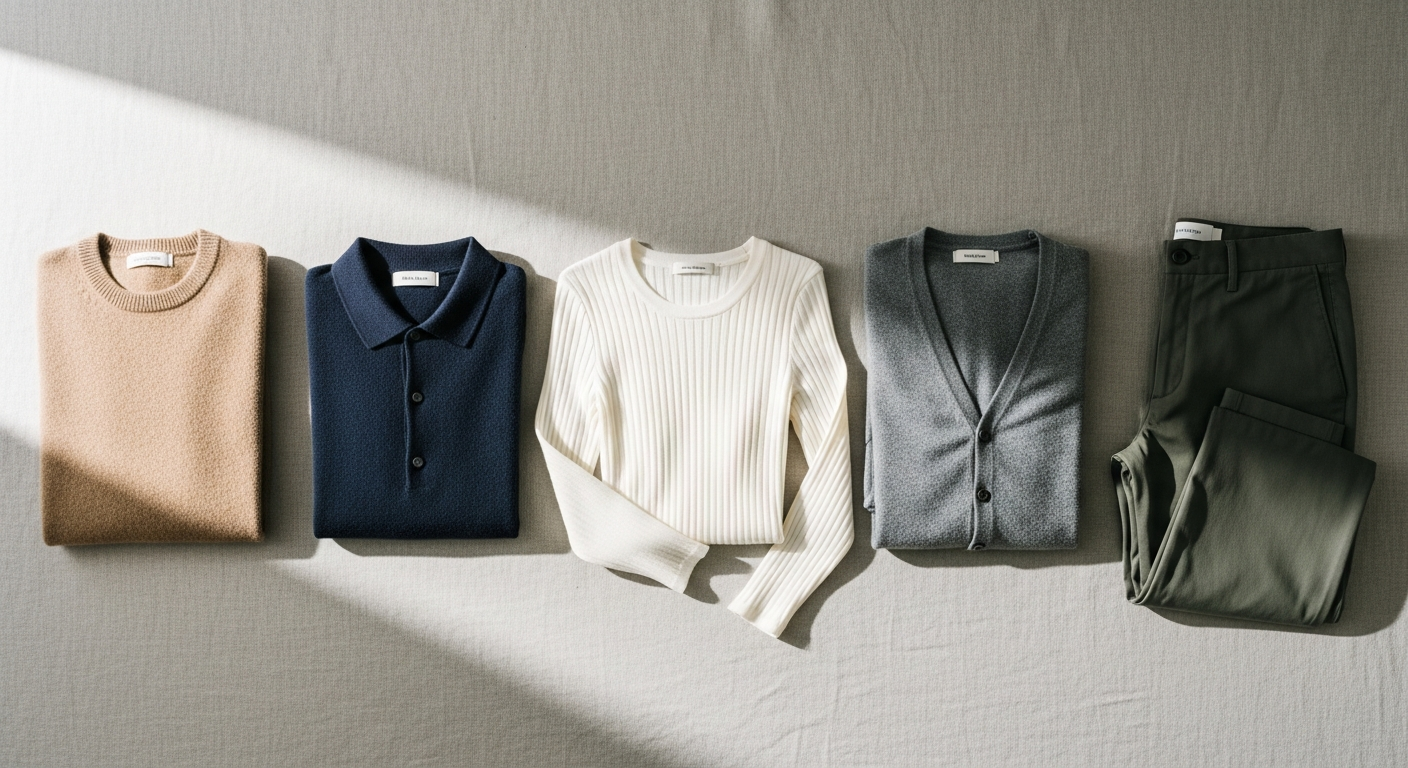
    Curated selection of essential merino garments laid flat on an antique Italian wooden table

    There is a phrase that keeps surfacing at the wool auctions in Sydney and Fremantle these weeks. The buyers say it under their breath: good spec lines. Higher-grade lots, scarce, sought after. It is the technical language of a market — and, without knowing it, also the language of those who long ago stopped buying to replace.

    Merino wool has become a precious material again, in the most literal sense. It is not an opinion, it is a fixing. The merino wool price of the Australian fibre has risen by more than forty percent in twelve months, reaching levels not seen since 2019. Demand grows, supply contracts, and the gap between the highest grades and standard wool widens every week.

    An economic story, read culturally

    One could read this story as purely economic, and stop there. But read culturally, it tells something else: nature, simply, is not infinite. A sheep produces three or four kilos of fleece per year. It takes months of grazing, sorting, shearing and washing before that fleece becomes a garment. That rhythm cannot be compressed to meet a demand spike.

    In an era when eighty consumers in a hundred describe themselves as value-seeking — looking for value, not discount — the rising cost of the natural raw material is the economic proof of a truth the world of quiet luxury has observed for years: buying less, buying better is not a moral posture, it is arithmetic. The cost per wear of a merino garment worn for ten seasons remains lower than the cost per wear of three synthetic garments bought to chase as many trends. Choosing premium merino wool, in this light, becomes the rational move.

    The validation of invisible luxury

    The rising price of wool is therefore not the triumph of conspicuous luxury. It is the validation of invisible luxury. Whoever wears a fine merino garment does not need a logo to know what they are wearing. They know that garment costs more — and lasts longer, and can be repaired, and will not end up in landfill after nine months. The price of the raw material becomes, then, the measure of value, not the problem.

    What remains to be seen is who will hear this signal, and who will keep pretending not to. The market has stopped being a backdrop: it has stepped onto the stage and taken the floor. It is saying, for those who care to listen, that the wardrobe that lasts — that ages well — is not nostalgia. It is, once again, a rational choice.


  • Buy less, buy true: Europe outlaws the destruction of unsold textiles

    Buy less, buy true: Europe outlaws the destruction of unsold textiles

    From 19 July 2026, large European companies will no longer be allowed to destroy unsold clothing, accessories and footwear. For the first time, our wardrobes are protected by law from the logic of excess. It is not a symbolic moratorium — it is a regulation, with reporting templates, deadlines and penalties.

    What changes on 19 July

    On 9 February 2026 the European Commission adopted, under the ESPR framework (Ecodesign for Sustainable Products Regulation), the rules that will apply this summer to companies with more than 250 employees. Medium-sized companies follow in 2030. Starting February 2027, all covered companies must declare, on a unified European template, the volumes of unsold goods disposed of as waste. Exceptions are narrow and strictly defined: safety risk, irreparable damage, chemical non-compliance.

    Why this news is more than news

    The numbers tell the story. In France alone, roughly €630 million worth of unsold goods are destroyed every year. In Germany, around 20 million online returns are discarded annually. Garments that were never worn, turned into waste before becoming wardrobes. The EU regulation does not ask the supply chain to communicate better: it asks the industry to produce so that unsold inventory is not the economic lever the model depends on.

    Invisible Luxury anticipates the law

    The core of the regulation is one simple sentence: less, better, longer. It is exactly the logic that drives the capsule wardrobe and the Cost Per Wear calculation. A garment designed to last two hundred wears never needed a ban to justify itself. But that logic now stops being a cultural choice and becomes the foundation of an industrial system. 19 July is not just a date: it is the moment durability becomes a requirement, not an option.

    What to do today

    Three practical gestures, today, three months before the deadline. One: look at your own wardrobe and identify the pieces that have held up for five years — they are the proof of what “narrative material” really means. Two: think in usage clusters, not isolated items, because the regulation rewards those who build systems and penalises those who accumulate. Three: ask your wardrobe for traceability the way you already ask it of your coffee. From which spinning mill, which facility, with which certification. Invisible Luxury begins with that question.


    Sources: European Commission, Business of Fashion, CMS Law-Now, ESG Today. ESPR Regulation (Ecodesign for Sustainable Products Regulation), adopted 9 February 2026, in force from 19 July 2026 for large companies.