

Author: Best before srl

  • The End of Disposable Fashion: What Changes in Your Wardrobe on July 19

    Close-up comparison of natural wool versus synthetic material in a textile atelier

    Picture a world in which every garment produced must find someone to wear it. It is not utopia: it is the European ESPR regulation — and it comes into force in less than ninety days.

    On 9 February 2026 the European Commission adopted the new implementing measures of the Ecodesign for Sustainable Products Regulation. From 19 July 2026, large textile companies will no longer be able to destroy unsold clothing, accessories and footwear. The EU textile ban applies first to large enterprises; medium-sized companies follow in 2030. Small businesses remain outside the rule for now — but the principle will likely cascade down.

    The numbers that drove the regulation

    The data that pushed Europe to legislate are well known, and they describe an industry that has long treated its finished product as scrap material. Between four and nine percent of the textiles placed on the European market are destroyed each year, before ever being worn. That waste generates roughly five million six hundred thousand tonnes of carbon dioxide — the equivalent of the net emissions of a country the size of Sweden.

    Garments were produced in order to burn them. The accurate word is burn: sometimes literally, more often metaphorically — but the meaning does not change.

    Three pieces, one direction

    The regulation does not arrive alone. On 27 September 2026 the EU greenwashing rules of the ECGT directive also enter into force, forbidding companies to make generic and unverifiable environmental claims — eco-friendly, sustainable, green — without documented proof. From 2027–2030 the Digital Product Passport will make a digital file mandatory for every garment, tracing origin, composition and impact.

    Read together, these three pieces form a precise direction: Europe is telling the fashion industry that the fast phase is over. Not because legislators chose so as a cultural statement, but because of cumulative pressure from data, consumers and ecological emergency. The market, for the first time, will no longer be allowed to produce more than it knows it can sell.

    What changes, concretely, in the wardrobe

    For the buyer, the translation is simple. The garment you will wear at the end of July will already be the child of a different industry. No longer an industry that burns leftovers, but one that calculates, plans and declares them. And which, for that reason, will have to produce less. Fewer collections, more targeted. Fewer surplus sizes, better chosen. Less hysterical seasonality, longer cycles.

    The capsule wardrobe, the cost per wear of clothing, the choice of natural fibres that age well — everything that quiet luxury has been proposing for years as a cultural posture — now becomes, in large part, the regulatory direction. A sustainable capsule wardrobe is no longer just style. It is law. Owning less, owning better is no longer a counter-narrative: it is the new baseline economy of the sector.

    Ninety-seven days remain to 19 July. Not much. But enough to do one concrete thing: open the wardrobe, count the garments you actually wear, and start thinking in capsules. The European rule is coming for the producers. It is worth getting there ahead, in your own wardrobe.


  • The Soul of Water: Why Biella Invented Italian Wool

    Historic textile machinery in a Biella mill, warm amber light

    There is an old way of saying “Made in Italy” that sounds like a stamp. And there is a new way — or perhaps an ancient one — that pronounces it the way one pronounces the name of a place: quietly, out of respect. Biella, during the nine days of the Made in Italy Week that closed on April 19th, pronounced it that way.

    The chosen theme of the 2026 edition was The Soul of Water. To many it sounded poetic. For those who know the textile district, it sounded, finally, anatomical.

    A garment born from a watershed

    An Italian merino wool garment is not born in a factory. It is born from a watershed, a microclimate, from streams that descend from the pre-Alps with low mineral content — three to eight French degrees of hardness, before industrial washing — and which for eight centuries have made it possible to wash, dye and finish the fibre with a purity other regions have never been able to imitate. This is the foundation of sustainable wool processing made in Italy.

    The piece that anchored the exhibition at Lanificio Maurizio Sella was called The Sovereign of Water. A collective installation made of fabrics donated by the district’s leading mills. Not a promotional manifesto: a tribute. For nine days, the companies stopped speaking of themselves to speak together of what precedes them all.

    Water precedes the mill. The mill precedes the brand. The brand precedes the garment. All of this, together, precedes the wardrobe of the person who will wear that garment.

    The competitive advantage is geological

    Biella’s competitive advantage is not a patent, not a logo, not a workshop secret. It is a geological element. The soft hand, the colour stability, the “Biella” finish that one recognises and cannot imitate — all of it derives, ultimately, from the composition of the water in the streams that cross the district. A chemical fact has become, over the centuries, a poetics of work. Choosing made in Italy wool means, in turn, choosing a water system.

    Biella’s luxury is invisible because it is hydrogeology. And a garment made here carries within it not only the hand of the artisan: it carries the imprint of a river.

    Perhaps this is the most honest reading to be made of a week that ended five days ago, but whose meaning remains. Here, no brand is being celebrated. Here, recognition is given to the landscape that made it possible.


  • When the Market Proves the Lasting Wardrobe Right

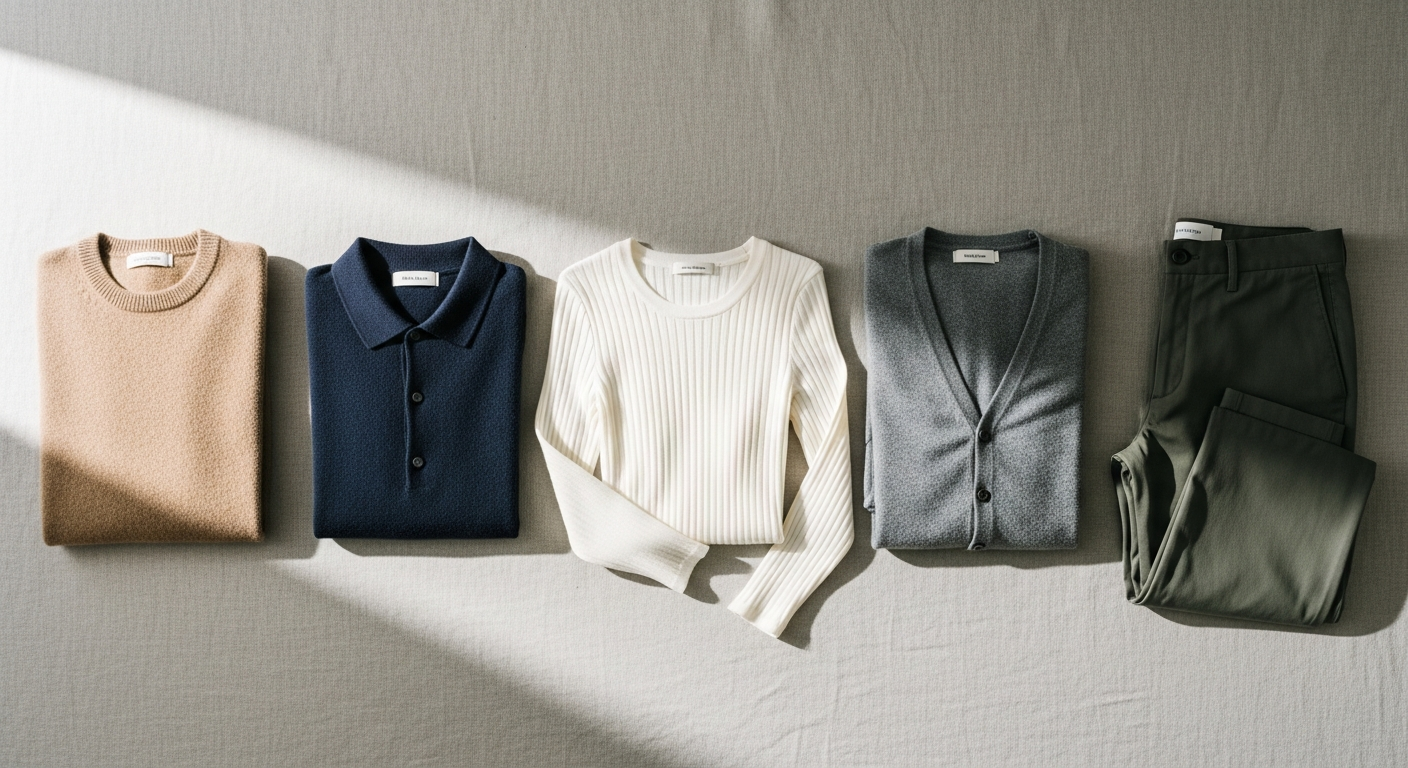
    Curated selection of essential merino garments laid flat on an antique Italian wooden table

    There is a phrase that keeps surfacing at the wool auctions in Sydney and Fremantle these weeks. The buyers say it under their breath: good spec lines. Higher-grade lots, scarce, sought after. It is the technical language of a market — and, without knowing it, also the language of those who long ago stopped buying to replace.

    Merino wool has become a precious material again, in the most literal sense. It is not an opinion, it is a fixing. The merino wool price of the Australian fibre has risen by more than forty percent in twelve months, reaching levels not seen since 2019. Demand grows, supply contracts, and the gap between the highest grades and standard wool widens every week.

    An economic story, read culturally

    One could read this story as purely economic, and stop there. But read culturally, it tells something else: nature, simply, is not infinite. A sheep produces three or four kilos of fleece per year. It takes months of grazing, sorting, shearing and washing before that fleece becomes a garment. That rhythm cannot be compressed to meet a demand spike.

    In an era when eighty consumers in a hundred describe themselves as value-seeking — looking for value, not discount — the rising cost of the natural raw material is the economic proof of a truth the world of quiet luxury has observed for years: buying less, buying better is not a moral posture, it is arithmetic. The cost per wear of a merino garment worn for ten seasons remains lower than the cost per wear of three synthetic garments bought to chase as many trends. Choosing premium merino wool, in this light, becomes the rational move.

    The validation of invisible luxury

    The rising price of wool is therefore not the triumph of conspicuous luxury. It is the validation of invisible luxury. Whoever wears a fine merino garment does not need a logo to know what they are wearing. They know that garment costs more — and lasts longer, and can be repaired, and will not end up in landfill after nine months. The price of the raw material becomes, then, the measure of value, not the problem.

    What remains to be seen is who will hear this signal, and who will keep pretending not to. The market has stopped being a backdrop: it has stepped onto the stage and taken the floor. It is saying, for those who care to listen, that the wardrobe that lasts — that ages well — is not nostalgia. It is, once again, a rational choice.


  • Buy less, buy true: Europe outlaws the destruction of unsold textiles

    Buy less, buy true: Europe outlaws the destruction of unsold textiles

    From 19 July 2026, large European companies will no longer be allowed to destroy unsold clothing, accessories and footwear. For the first time, our wardrobes are protected by law from the logic of excess. It is not a symbolic moratorium — it is a regulation, with reporting templates, deadlines and penalties.

    What changes on 19 July

    On 9 February 2026 the European Commission adopted, under the ESPR framework (Ecodesign for Sustainable Products Regulation), the rules that will apply this summer to companies with more than 250 employees. Medium-sized companies follow in 2030. Starting February 2027, all covered companies must declare, on a unified European template, the volumes of unsold goods disposed of as waste. Exceptions are narrow and strictly defined: safety risk, irreparable damage, chemical non-compliance.

    Why this news is more than news

    The numbers tell the story. In France alone, roughly €630 million worth of unsold goods are destroyed every year. In Germany, around 20 million online returns are discarded annually. Garments that were never worn, turned into waste before becoming wardrobes. The EU regulation does not ask the supply chain to communicate better: it asks the industry to produce so that unsold inventory is not the economic lever the model depends on.

    Invisible Luxury anticipates the law

    The core of the regulation is one simple sentence: less, better, longer. It is exactly the logic that drives the capsule wardrobe and the Cost Per Wear calculation. A garment designed to last two hundred wears never needed a ban to justify itself. But that logic now stops being a cultural choice and becomes the foundation of an industrial system. 19 July is not just a date: it is the moment durability becomes a requirement, not an option.

    What to do today

    Three practical gestures, today, three months before the deadline. One: look at your own wardrobe and identify the pieces that have held up for five years — they are the proof of what “narrative material” really means. Two: think in usage clusters, not isolated items, because the regulation rewards those who build systems and penalises those who accumulate. Three: ask your wardrobe for traceability the way you already ask it of your coffee. From which spinning mill, which facility, with which certification. Invisible Luxury begins with that question.


    Sources: European Commission, Business of Fashion, CMS Law-Now, ESG Today. ESPR Regulation (Ecodesign for Sustainable Products Regulation), adopted 9 February 2026, in force from 19 July 2026 for large companies.

  • The Minimalist Men’s Wardrobe: How Fewer Pieces Create More Style

    The Minimalist Men’s Wardrobe: How Fewer Pieces Create More Style

    Minimalist men’s fashion isn’t about having nothing. It’s about having nothing unnecessary.

    The Paradox of the Full Closet

    Research from the Journal of Consumer Psychology shows that increasing clothing options beyond a threshold actually decreases satisfaction with our choices. Every morning, a full wardrobe presents not freedom but friction. Minimalist men’s fashion resolves this: fewer decisions, faster mornings, more consistent style. The capsule wardrobe for men is the practical application of this principle.

    The Architecture of a Minimalist Wardrobe

    A functional minimalist wardrobe operates on three principles: combinability (every piece works with every other piece), versatility (each garment spans at least two contexts), and durability (nothing needs replacing within a year).

    The foundation layer matters most. A superfine Merino t-shirt in your core neutral — white, charcoal, or navy — anchors the entire system. At 17 microns, it’s invisible under a blazer yet substantial enough to stand alone. It thermoregulates across seasons, resists odor for days, and maintains its shape after hundreds of wears. This is why Merino is the material of choice for men’s wardrobe essentials.

    The 12-Piece Formula

    Twelve carefully chosen pieces generate 30+ distinct outfits. Here’s the arithmetic of a capsule wardrobe for men:

    Base layer (3 pieces): Two Merino t-shirts (one light, one dark) plus one Oxford shirt. These three tops combine with everything below them.
    Mid layer (2 pieces): One structured blazer, one lightweight Merino knit. Temperature modulators that transform any outfit’s formality.
    Bottom layer (3 pieces): Chinos, dark denim, tailored trousers. Each pairs with every top and mid-layer combination.
    Outer layer (1 piece): A clean-lined jacket in technical fabric. Rain or chill, one piece covers both.
    Footwear (2 pairs): Leather lace-ups for formal contexts, clean sneakers for everything else.
    Accessories (1 piece): A quality leather belt that works across all combinations.

    3 × 2 × 3 = 18 top-bottom-layer combinations. Add outerwear variants and you exceed 30 outfits from 12 pieces.

    Why Quality Is the Only Minimalist Strategy That Works

    Minimalist men’s fashion fails when built on disposable clothing. If your base t-shirt pills after 15 wears, you need three replacements per year — and your “minimalist” wardrobe becomes a revolving door. Investment dressing and minimalism are inseparable: the cost per wear of quality Merino (€0.63) proves that buying better means buying less, permanently.

    CompACT® spinning technology and plasma treatment give Merino its extraordinary longevity. Anti-Pilling properties preserve the surface. GSM-optimized weight ensures year-round comfort. Cut & Sewn construction — not Fully Fashioned knitting — delivers the architectural precision that minimalist wardrobes demand.

    The Invisible Uniform

    Steve Jobs had his turtleneck. Obama limited his suits to two colors. The most productive people on earth discovered what minimalist men’s fashion practitioners already know: the best wardrobe decisions are the ones you never have to make. A capsule wardrobe for men isn’t a constraint. It’s a system that returns your morning attention to things that actually matter.

    Start with the foundation. One superfine Merino t-shirt. Wear it Monday. Wear it Thursday. Notice how everything else in your wardrobe suddenly makes sense.

    Dive deeper: The 7 Foundation Pieces | The Cost-Per-Wear Formula | The Science of Textile Essentialism

    World of Merino — Less wardrobe. More life.


    Want to build a wardrobe that truly works?

    Download the guide: The Invisible Wardrobe — 12 pieces, 30 days, fewer decisions.

    FEWER PIECES, MORE STYLE

    A Wardrobe Built to Last

    Discover garments crafted for those who choose Italian sartorial quality.
    Fewer decisions, more substance.

    Discover Perfect Merino Shirt
  • Investment Dressing for Men: The Cost-Per-Wear Formula That Changes How You Shop

    Investment Dressing for Men: The Cost-Per-Wear Formula That Changes How You Shop

    Price is what you pay. Cost per wear is what it actually costs you.

    The €125 Question

    A €125 t-shirt sounds expensive. A €25 t-shirt sounds reasonable. But investment dressing asks the only question that matters: what does each wear actually cost you?

    The €25 t-shirt: worn 15 times before it pills, stretches, or fades. Cost per wear: €1.67. The €125 Merino t-shirt: worn 200+ times, maintaining its form, color, and performance throughout. Cost per wear: €0.63. The “expensive” shirt costs 62% less per use. This is the mathematics behind every capsule wardrobe for men that actually works.

    Why Cost Per Wear Matters More Than Price Tags

    The fashion industry relies on a cognitive bias: we evaluate price at purchase, not cost over time. Investment dressing reverses this. When you calculate cost per wear, the hierarchy of value inverts completely:

    • Fast fashion cotton tee (€15, 10 wears): €1.50/wear
    • Mid-range cotton tee (€45, 30 wears): €1.50/wear
    • Premium Merino tee (€125, 200+ wears): €0.63/wear

    The premium option isn’t just cheaper per wear — it eliminates the replacement cycle. No quarterly shopping trips. No decision fatigue in stores. No accumulating waste.

    The Science Behind 200+ Wears

    How does a single garment survive 200+ wears? The answer is material science: 17 micron superfine Merino wool processed with CompACT® spinning technology and plasma treatment. These three elements create a fabric with natural Anti-Pilling resistance, shape retention that outlasts any cotton, and fibers that actively manage moisture and odor — meaning fewer washes, less degradation, longer life.

    Investment Dressing as Minimalist Strategy

    For men building a minimalist wardrobe, investment dressing isn’t optional — it’s the foundation. Each piece must justify its space through performance and longevity. A Merino t-shirt serves as the invisible base layer for men’s wardrobe essentials: it performs under a blazer, on a plane, at dinner, and at home. One piece, every context, every season.

    The capsule wardrobe for men doesn’t work with disposable clothing. It works when every piece is built to last, designed to combine, and engineered to improve with age. That’s investment dressing: spending more now to spend nothing later.

    The Compound Effect

    Replace five €25 t-shirts with one €125 Merino tee. In year one, you save €0. In year two, while others repurchase, you save €125. By year three: €250 saved, plus the hours not spent shopping, deciding, and discarding. Investment dressing compounds — in money, time, and environmental impact.

    World of Merino — Quality you feel. Mathematics you can prove.

    Your Next Step

    Investment dressing starts with fewer pieces chosen with more intention. The mathematics are clear: one €125 Merino t-shirt outperforms five disposable alternatives in every metric that matters.

    Build your foundation: The 7 Essential Pieces | The Minimalist Wardrobe Guide | Cost Per Wear — The Science


    Want to build a wardrobe that truly works?

    Download the guide: The Invisible Wardrobe — 12 pieces, 30 days, fewer decisions.

    FEWER PIECES, MORE STYLE

    A Wardrobe Built to Last

    Discover garments crafted for those who choose Italian sartorial quality.
    Fewer decisions, more substance.

    Discover Perfect Merino Shirt
  • Men’s Wardrobe Essentials: The 7 Foundation Pieces That Replace Everything

    Men’s Wardrobe Essentials: The 7 Foundation Pieces That Replace Everything

    The smartest wardrobe isn’t the fullest. It’s the one where every piece earns its place.

    The Problem with “More”

    The average man owns 85 garments and wears 30% of them. The rest occupy space, collect dust, and silently depreciate. Men’s wardrobe essentials aren’t about restriction — they’re about precision. Seven foundation pieces, chosen with intention, can cover every context from Monday boardroom to Saturday market.

    The 7 Foundation Pieces

    1. The Invisible Base Layer. A superfine Merino t-shirt in a neutral tone. This is the piece you never think about but always rely on. It thermoregulates under a blazer, resists odor across time zones, and maintains its shape after 200+ wears. At €0.63 per wear, it’s the most economical garment in your wardrobe. This is the anchor of capsule wardrobe men trust.

    2. The Structured Blazer. Navy or charcoal, unlined for three-season versatility. It transforms the Merino base layer from casual to professional in seconds.

    3. The Perfect Chino. A mid-weight cotton-blend in stone or slate. Bridges the gap between formal trousers and jeans.

    4. Dark Denim. Raw or rinsed, slim-straight cut. The evening alternative to chinos that works with every top in your rotation.

    5. The Oxford Shirt. White or pale blue. The failsafe for when a t-shirt won’t do. Layer it under the blazer or roll the sleeves for weekend.

    6. The Merino Knit. A lightweight crew or V-neck in a tonal shade. Your layering secret weapon for temperature drops.

    7. The Versatile Outerwear. A clean-lined jacket that transitions from rain to chill. Technical fabric, minimal design.

    Why Merino Is the Foundation of Minimalist Men’s Fashion

    Among these men’s wardrobe essentials, the Merino t-shirt is unique: it’s the only piece engineered for invisible performance. 17 micron superfine fibers provide natural thermoregulation, moisture management, and odor resistance — properties no cotton or synthetic can match. For men building a capsule wardrobe, this single piece replaces three conventional t-shirts and reduces decision fatigue every morning.

    The Mathematics of Fewer, Better Pieces

    Seven pieces. 30+ distinct outfits. That’s not minimalism as sacrifice — it’s minimalism as strategy. When every garment in your wardrobe works with every other garment, you eliminate the “full closet, nothing to wear” paradox entirely. The cost-per-wear of each piece drops below €1 within the first season. Investment dressing, proven by mathematics.

    World of Merino — The science of wearing less, but better.

    Start Building Your Essential Wardrobe

    The quality of your wardrobe essentials determines everything: your cost per wear, your morning routine, your environmental impact. Choosing fewer pieces of exceptional quality isn’t just style advice — it’s the most rational approach to getting dressed.

    Explore the science behind these choices: The Cost Per Wear Guide | Textile Essentialism | Investment Dressing: The Formula


    Want to build a wardrobe that truly works?

    Download the guide: The Invisible Wardrobe — 12 pieces, 30 days, fewer decisions.

    FEWER PIECES, MORE STYLE

    A Wardrobe Built to Last

    Discover garments crafted for those who choose Italian sartorial quality.
    Fewer decisions, more substance.

    Discover Perfect Merino Shirt
  • The Elegance That Doesn’t Ask for Attention: When Invisible Comfort Speaks

    There is a scene that repeats in every period film, and perhaps in every man’s life: the moment he puts on something that fits perfectly — and the mirror doesn’t reflect a costume, but a version of himself he recognizes.

    True elegance, the kind that transcends trends, has a very precise characteristic: it doesn’t shout. It whispers. And it whispers because it doesn’t need confirmation from others — it already has the wearer’s.

    The paradox of visible luxury

    For years they taught us that elegance is something to display: a visible logo, a recognizable brand, an intentional price tag. But the most enduring form of elegance is the one that subtracts. It’s not about what you add — it’s about what you no longer need.

    Elegance isn’t about being noticed, but about being remembered. And you’re remembered for how you made others feel, not for what you wore.

    The feeling on the skin as the first layer of style

    We often think of style as something purely visual. But the first experience of a garment is tactile: how it feels against the body, how it moves with you, whether it restricts or liberates. A fine merino garment is perceived before it is seen.

    When you wear an “inert” material, your body fights it: adjusting, pulling, scratching. When you wear something that breathes and thermoregulates with you, the body forgets the garment. And that forgetting is the first sign of true comfort — which is the first sign of true style.

    Subtract to add value

    Reaching this state of “invisible comfort” requires construction, not decoration. It requires knowing your fibers, your fabric weights, your body. It means choosing pieces where the quality lies in the structure — not in the ornament. Not in what you see, but in what you feel.

    An investment in yourself

    Ultimately, choosing elegance that doesn’t demand attention is a form of self-love that needs no audience. It’s choosing to dress for how the garment makes you feel — not for how it makes you appear. And this is perhaps the most intimate choice a man can make in his wardrobe.


    Explore: Why does simplicity cost more?

    Making a t-shirt that lasts three years requires a fiber three times more refined. Here’s where the invisible cost of material quality lies.

    Read on Merino University → The hidden cost of quality


    Want to build a wardrobe that actually works?

    Download the guide: The Invisible Wardrobe — 12 pieces, 30 days, fewer decisions.

    FEWER PIECES, MORE STYLE

    The Wardrobe that Lasts Through Time

    Discover pieces designed for those who choose Italian sartorial quality.
    Fewer decisions, more substance.

    Discover Perfect Merino Shirt
  • The 8-Hour Rule: From Morning to Evening Without Losing Shape

    There is a precise moment we all know. It’s that glance in the mirror at 8 PM, after a full day — meetings, commuting, lunches, unexpected situations — when you discover that the garment you’re wearing has surrendered before you have.

    The 8-Hour Rule says something simple: a garment should not just look good in the morning — it should hold up at the end of the day. And holding up doesn’t mean being rigid. It means maintaining its shape, comfort, and dignity even after hours of real use.

    The invisible decay (and the mental cost)

    We often accept this decay as normal. We think it’s the body’s fault, the weather, the movement. But often it’s the material that fails, not you. A synthetic fabric that doesn’t breathe, a weave that deforms under tension, a fiber that pills after a few hours.

    The elegance a professional in motion needs is not static. It’s a dynamic elegance that follows the body without fighting it. And this is only possible with materials that react to movement instead of suffering from it.

    Elegance isn’t how you leave the house. It’s how you come back in.

    Stability vs. Rigidity

    How do you pass the 8-hour test? Many think the solution is a stiff, structured fabric. But a rigid garment doesn’t hold up — it resists. And resistance breaks. True stability comes from elasticity: a natural fiber that deforms under stress and returns to its original shape when the stress stops.

    The 8 PM test

    Want to know which pieces in your wardrobe pass the rule? Try the 8 PM test. After a full day, stand in front of the mirror and ask yourself these questions:

    Does the fabric still fall straight or has it taken the shape of the chair? Have creases appeared where there shouldn’t be any? Does it still feel fresh on the skin or does it feel damp, heavy? If the garment fails even one of these three questions, it doesn’t pass. And a garment that doesn’t pass the 8-hour test is one you’ll eventually replace.


    Explore: The science of recovery

    Why do some fabrics bounce back on their own while others give up? The answer lies in the microscopic structure of the fiber.

    Read on Merino University → Why some garments recover better than others


    Want to build a wardrobe that actually works?

    Download the guide: The Invisible Wardrobe — 12 pieces, 30 days, fewer decisions.

    FEWER PIECES, MORE STYLE

    The Wardrobe that Lasts Through Time

    Discover pieces designed for those who choose Italian sartorial quality.
    Fewer decisions, more substance.

    Discover Perfect Merino Shirt
  • The Sunday Coat and the Monday T-Shirt: When Habit Becomes Style

    There is a type of elegance that you don’t see right away. It doesn’t ask for attention, it doesn’t make noise. It’s a coat that falls the right way, that wraps you without squeezing, that makes every gesture look considered — even when it isn’t.

    Sunday often has a ritual: the “good” coat, the one that makes you feel more present. A garment that holds within it a story of taste, of times when getting dressed meant honoring oneself and others. This idea of clothing as a gesture of respect is at the heart of a quality wardrobe.

    The best style is the one that doesn’t demand energy.

    Two garments, two functions: ritual and routine

    The ritual is a signal. It’s that gesture that says: “today I’m present.” The Sunday coat, the father’s jacket for important occasions — these garments carry meaning that goes beyond the fabric.

    Routine, on the other hand, doesn’t need signals: it needs continuity. The reliable everyday coat, the jacket you throw on without thinking. These are the pieces that become part of you — always ready, always right.

    And this is where a seemingly simple garment becomes fundamental: not because of what it communicates, but because of what it solves. Every morning, without effort.

    When a garment becomes automatic

    There is a test much more honest than any definition: how many times do you reach for it without thinking? A garment that becomes “automatic” is the one your hand finds before your mind decides. It’s the real proof of quality.

    1) It gives you back time

    Time isn’t just the time in front of the wardrobe. It’s mental time: how many seconds do you spend wondering “does this work?” A garment that works every time eliminates an invisible decision. And invisible decisions are the ones that drain you most.

    2) It gives you back calm

    A “stable” garment reduces the subtle anxiety of “I wonder how I look.” It’s not about vanity. It’s about the calm of knowing you’re wearing something that works without adjustments, without second thoughts, without compromise.

    3) It gives you back consistency

    There is a reason why some people always look elegant without effort: they have found their pieces. Their personal uniform. It’s not about having only one coat — it’s about knowing that every coat in the wardrobe speaks the same language.

    The personal uniform isn’t boredom: it’s consistency

    The word “uniform” scares because we associate it with giving up. In reality, it means choosing a recognizable aesthetic range where everything works with everything. Colors, weights, fabrics that know each other. This is the secret of those who seem to always be well-dressed: they haven’t chosen more — they’ve chosen better.

    Small gestures that make the habit last

    A garment becomes habit when you know you can “count on it.” And trust is maintained with care. Not obsessive care — just aware. Air it after wearing. Brush wool periodically. Use the right hangers. Fold knitwear instead of hanging it.

    These are minimal gestures, but they do something enormous: they transform a garment into a constant. And a constant, in a world of disposable things, is the real luxury.

    The point isn’t buying more. It’s choosing what supports you.

    The difference between a full wardrobe and a useful wardrobe isn’t the number. It’s the intention. When each garment is chosen to stay, every opening of the wardrobe becomes simple. No noise. No regrets. Only pieces that work.


    Explore

    Why do some garments remain “stable” on the skin and throughout the day, without pilling, deforming or losing softness?

    Quality of use: the signals that matter more than claims →


    Want to build a wardrobe that actually works?

    Download the guide: The Invisible Wardrobe — 12 pieces, 30 days, fewer decisions.

    FEWER PIECES, MORE STYLE

    The Wardrobe that Lasts Through Time

    Discover pieces designed for those who choose Italian sartorial quality.
    Fewer decisions, more substance.

    Discover Perfect Merino Shirt