
Wearing Italy Daily
Made in Italy in clothing evokes images of Milan runways, ateliers, and four-figure prices. But the most authentic Italian textile tradition is not the one that ends up in magazines — it’s the one you wear every day, without thinking about it, because it works. This article tells that story: the supply chain, the people, the quality you feel on your skin but don’t see from the outside.
Beyond the brand: what “Made in Italy” really means in textiles
“Made in Italy” is protected by Italian law and EU regulation 952/2013: it indicates that substantial processing of the product has occurred in Italy. But “substantial processing” covers a broad spectrum — from the final cutting and sewing of imported fabric to the complete supply chain from raw fiber to finished garment.
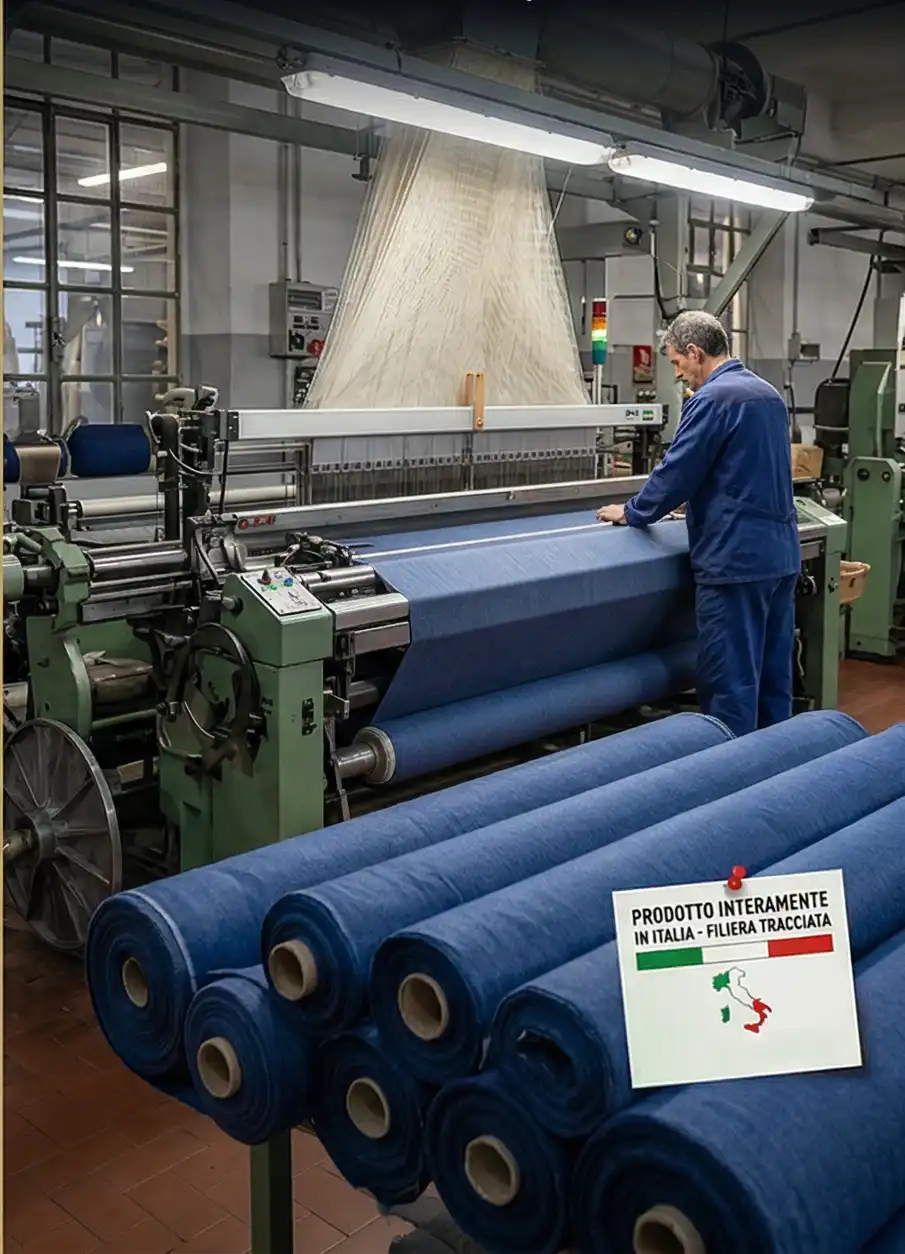
The difference between these two extremes is enormous. A company that imports fabric from China and cuts it in a Prato workshop can legally write Made in Italy. A company that starts from raw fiber, spins it, weaves it, dyes it, and finishes it entirely in the Biella district is doing something radically different — but the label is the same.
For the conscious chooser, the question is not “where is it made?” but “how much of the supply chain is Italian?”. It’s the difference between a brand and a story — between a label and a real guarantee of quality.
The Biella district: where wool becomes fabric
Piedmont hosts the highest concentration of woolen mills in the world. The Biella district — an area spanning just a few dozen square kilometers between the Prealps — has been transforming raw fiber into finished fabrics for over 500 years. This is not a nostalgic historical fact: it’s an active production ecosystem with expertise that doesn’t exist elsewhere.
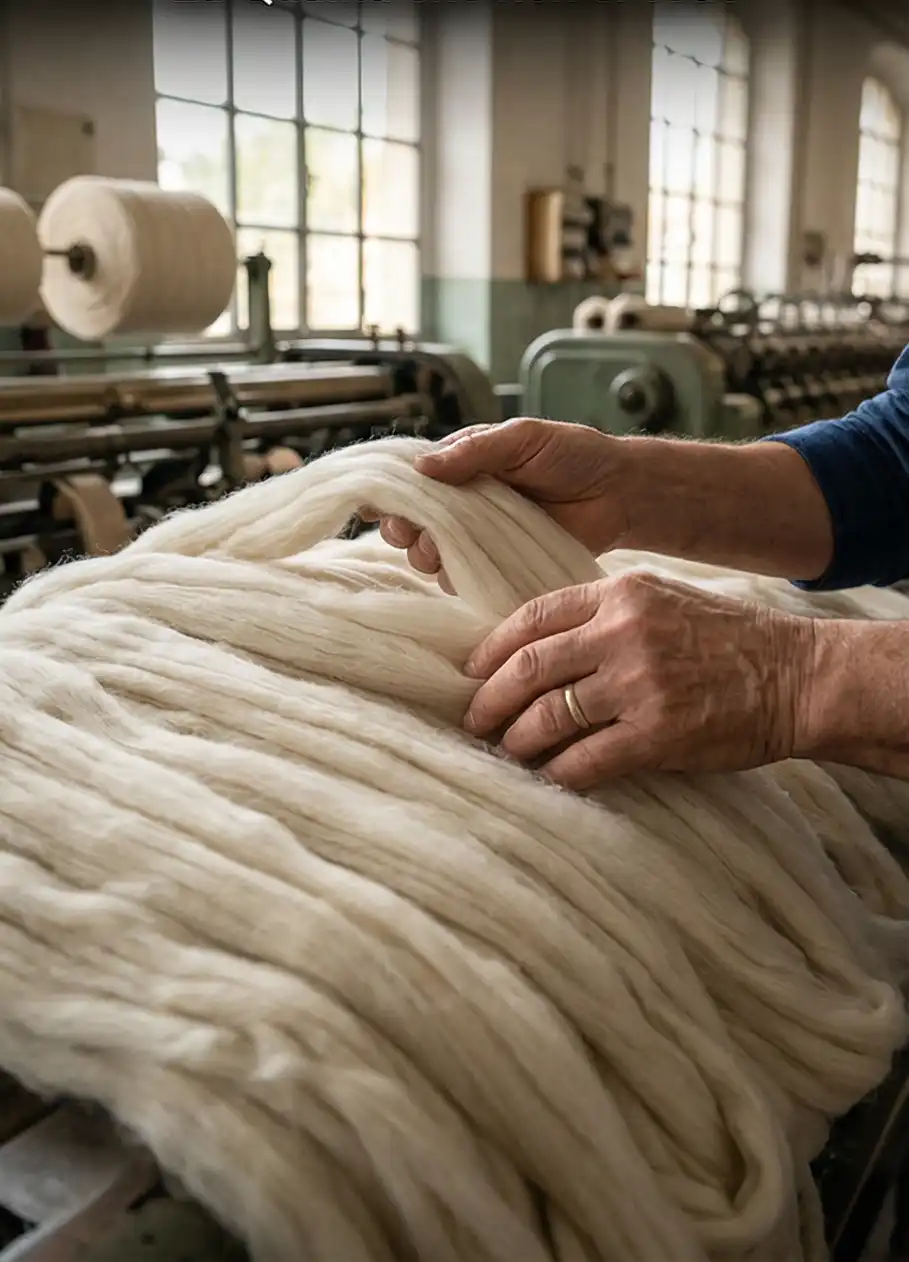
Merino wool arriving from Australia and New Zealand is selected here for fineness (the best batches are under 17.5 micron), washed with processes that recover 95% of the water, spun with machinery that balances twist and strength, and woven with densities calibrated to the gram. Each step requires specific skills — and each skill is the result of generations of refinement.
When you wear a garment in merino processed through this supply chain, you’re literally wearing centuries of applied knowledge. It’s not romanticism — it’s textile engineering, perfected by time.
Quality you can’t see: three measurable differences
The complete Italian supply chain produces garments with measurable technical characteristics — not subjective perceptions.
Fiber uniformity. Italian merino batch selection is more restrictive than the industrial average: the standard deviation of fiber diameter (the “comfort factor”) is controlled batch by batch. The result is more uniform fabric, which translates to a constant sensation on the skin with no irritation.
Pilling resistance. Italian long-fiber spinning (worsted) produces yarn with fewer short fibers on the surface. Fewer short fibers = less pilling. An Italian merino worsted garment maintains a smooth appearance for hundreds of washes — not dozens.
Dimensional stability. Italian finishing treatments (thermofixing, decating) stabilize the fabric before sewing. The garment you buy in size M will still be a size M after your fiftieth wash. In an accelerated supply chain, this phase is often compressed or skipped.
Made in Italy daily: not luxury, but choice
There’s a deep misunderstanding about Italian textiles: that they’re synonymous with inaccessible luxury. The reality is that the Biella supply chain produces for every market segment — and the cost difference between a garment from a complete Italian supply chain and one from a mixed supply chain is often less than you’d think, especially when calculated on a cost-per-wear basis.
Choosing a garment from the Italian supply chain is not an act of luxury: it’s an informed decision about quality, durability, and the kind of economy you want to support. It’s wearing Italy in the most concrete sense — not as a label, but as a daily experience of comfort and longevity.

To understand in detail how raw fiber becomes the garment you wear, the Dal Vello al Capo journey on Merino University tells the story of every stage of transformation. And to feel on your skin what a complete Italian supply chain means, the 17 micron merino t-shirt is the synthesis of everything we’ve explained.
Related Reading
Want to understand the science behind the materials?
Explore Merino University →