
Invisible Quality
How do you distinguish a merino garment from an authentic Italian supply chain from one that carries the same label but has traveled through an entirely different production chain? Not from the logo, not from the price — but from five technical indicators that anyone can verify. This guide explains them, makes them recognizable, and gives you the tools to choose consciously.
Indicator 1: The Hand Feel of the Fabric
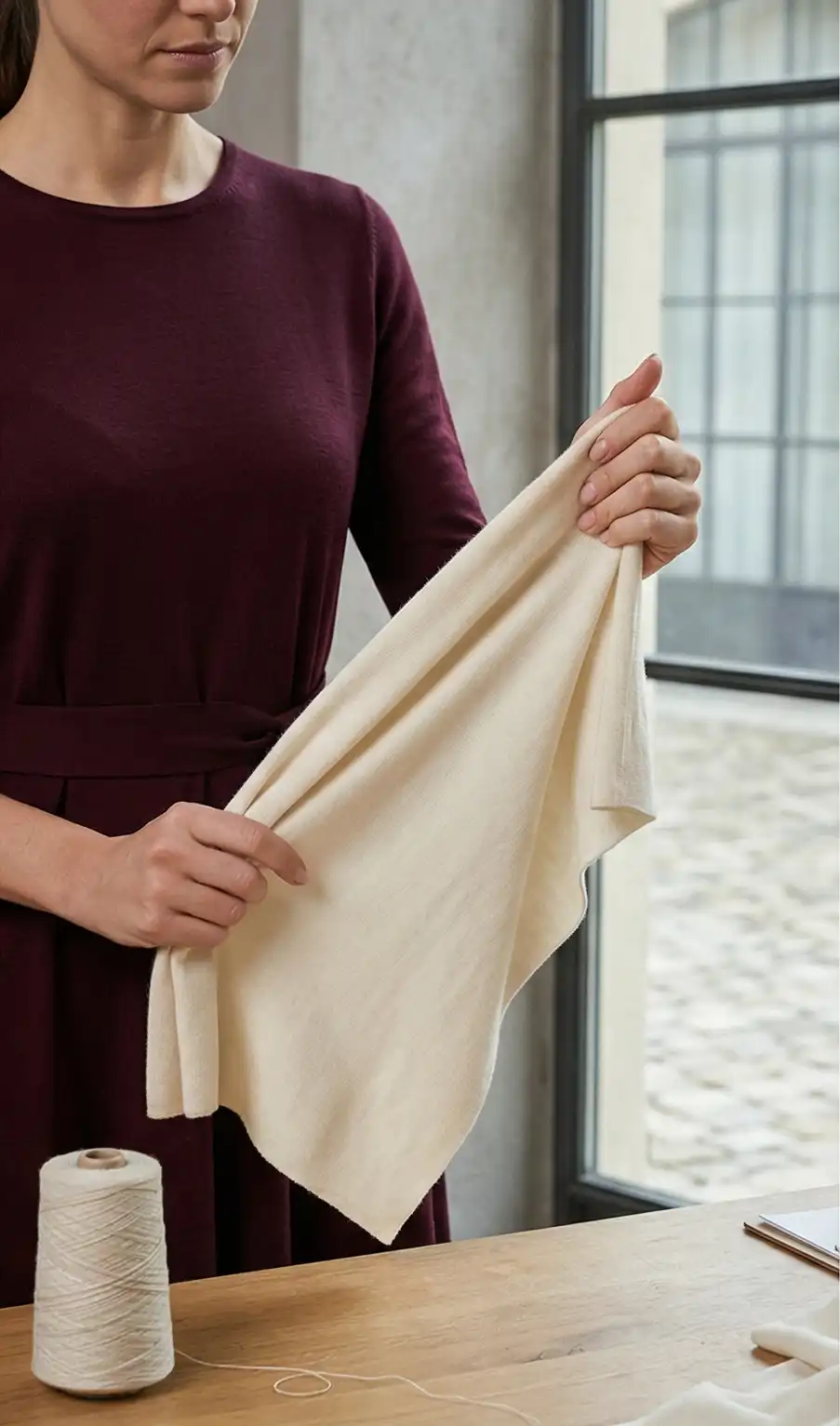
Textile experts call it “hand feel” — the tactile sensation of the fabric between your fingers. It’s the first test and the most immediate. Quality merino from an Italian supply chain has a hand that technicians define as “silky with body”: it slides between your fingers without perceptible friction, but has an internal structure that resists pressure.
The comparison with merino from an accelerated industrial supply chain is evident: the latter tends to have a “flat” hand — soft but lacking body, as if a layer of depth were missing. The difference originates in the spinning process: the Italian worsted process maintains the natural alignment of fibers, preserving their intrinsic elasticity. Faster spinning sacrifices this alignment for production speed.
Practical test: take the fabric between thumb and forefinger and rotate it gently. Quality merino returns to its original position with a perceptible elastic “memory.” Industrial merino stays where you leave it.
Indicator 2: Visual Uniformity
Hold the fabric up to light, preferably with lateral natural light. Fabric from an Italian supply chain shows a uniform surface without areas of different density or transparency. This is the result of fiber selection: when the average diameter of merino is below 17.5 microns with a contained standard deviation, the resulting yarn has a constant cross-section that produces a homogeneous fabric.
In fabric from a mixed supply chain — where fiber batches are blended to reduce costs — you can notice subtle variations in density, especially in light colors. It’s not a visible defect from a distance, but becomes apparent when wearing the garment: thinner areas wear out first, creating non-uniformity after a few months of use.
Indicator 3: Tensile Strength
The simplest and most revealing test. Take the fabric with both hands and pull it gently diagonally (at 45° to the weave). Italian worsted merino resists traction and returns to its original shape when you release it. Lower quality fabric yields visibly and shows residual deformation.
This resistance is the direct result of Italian finishing — in particular decatizing, a thermal stabilization process that “locks” fibers into their optimal position. It’s a step that requires time, energy, and specific expertise. In supply chains that compress production time, it’s often reduced or eliminated, with direct consequences for the garment’s durability over time.

Indicator 4: Behavior After Washing
The true test of quality textile is not the appearance when new, but after the tenth wash. Merino from a complete Italian supply chain maintains color, dimensions, and hand feel practically unchanged. Shrinkage is under 1% — often imperceptible.
In a garment from an industrial supply chain, the fifth-eighth wash is the critical point: the first signs of pilling (those small balls of fiber on the surface) begin to appear, seams may show different tensions, and the hand feel loses its initial softness. This isn’t a “defect” — it’s simply the result of less selected fiber and faster finishing.
Washing reveals the hidden quality that new appearance can mask. This is why Italian weavers say that true fabric is judged after six months, not in the shop.
Indicator 5: Supply Chain Transparency
The final indicator is not technical, but informational. A producer who controls the Italian supply chain has no reason to hide it — in fact, they communicate it. Look for this information: fiber origin (country, region, micron count), location of spinning and weaving, type of finishing. If a brand only talks about “Made in Italy” without specifying what was made in Italy, that’s a signal worth investigating.
Transparency isn’t marketing — it’s responsibility. Those who invest in a complete Italian supply chain want you to know what you’re buying, because that knowledge justifies the choice.
From Theory to Practice
These five indicators don’t require tools or technical expertise — just attention and a minimum of practice. Use them the next time you evaluate a merino garment and you’ll notice differences that previously went unnoticed.
To dive deeper into the science behind fiber quality, the learning path on keratin structure on Merino University explains how molecular composition influences every property you’ve just learned to recognize. And to put these indicators into practice on a real garment, the 17 micron merino t-shirt lets you verify all five tests from the first wearing.
Related Reading
Want to understand the science behind the materials?
Explore Merino University →