
When traveling for business, you don’t need to “stay warm” or “stay cool.” You need to stop thinking about it altogether. The real challenge isn’t the absolute temperature—it’s the sequence: the plane is freezing, the airport is tepid, the taxi is stifling, and the boardroom is set to precisely 19 degrees Celsius.
Your body expends energy adapting to these constant shifts. If your clothing works against you, you’ll arrive at your meeting exhausted before it even begins. This guide is your system: how to choose and combine a few pieces to navigate these swings without changing your outfit and without losing your mental edge.
The Real Enemy: Temperature Swings (Not the Season)
We often dress based on the weather forecast for our destination. That’s a mistake. On a business trip, you spend 90% of your time in artificially climate-controlled environments that have nothing to do with the weather outside. Your outfit must be your buffer.
The Solution Is a System, Not a Single Garment
There’s no magic blazer. There is, however, a three-layer system that works consistently—from flights in winter to tropical boardrooms. These three layers manage temperature without bulk, maintain composure under stress, and work both under a blazer and alone.
Layer 1: The Base Layer—Merino, Not Cotton
Start with a Superfine Merino t-shirt or long-sleeve base. Merino has a unique advantage: it regulates temperature intelligently. When you’re cold, it insulates; when you’re warm, it wicks moisture and cools you. Cotton does neither—it absorbs sweat and holds it against your skin, making you colder later.
At €125 per piece, a Superfine Merino tee isn’t an expense—it’s your foundational investment. One garment worn twice weekly for 5+ years keeps your Cost Per Wear under €5.
Layer 2: The Mid-Layer—The Invisible Blazer
A lightweight wool sweater or cardigan in charcoal or navy works as your thermal buffer. It’s thin enough to fit under any blazer, but substantial enough to hold heat without weight. If you’re in a boardroom and everyone’s coats are off, this layer lets you control your temperature without appearing unprepared.
Choose a wool blend that’s wrinkle-resistant. After a 12-hour travel day, you don’t have time for ironing—your clothes must perform as-is.
Layer 3: The Outer Layer—The Structure
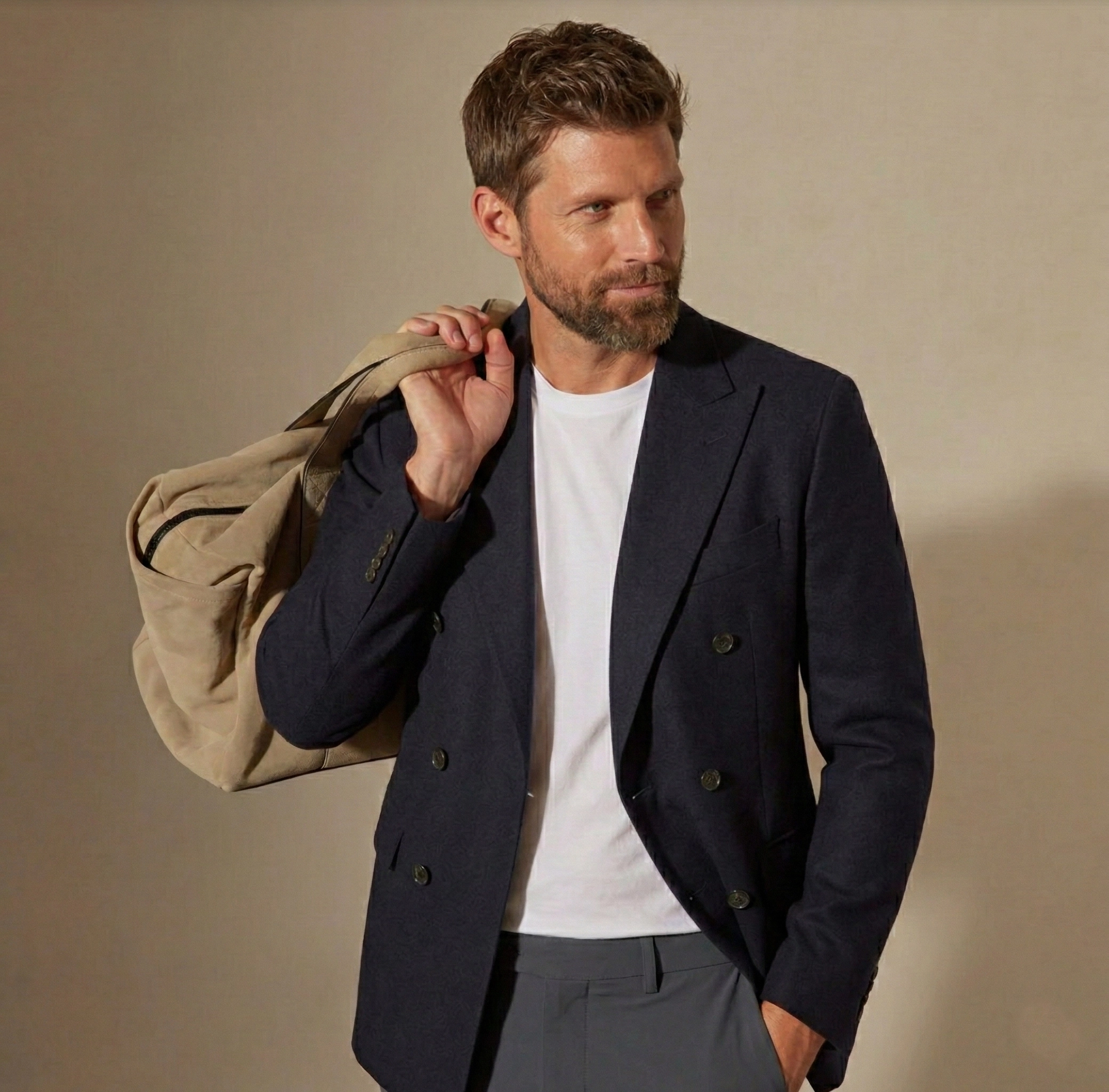
A tailored blazer in a neutral color. It isn’t decorative—it’s functional. It creates the boundary between your body’s microclimate and the external environment. The blazer also signals professionalism, which has its own psychological weight in the boardroom.
The Packing Formula
For a 3-day business trip: 2 Superfine Merino base layers (one light gray, one white), 1 mid-layer sweater, 1 blazer, 1 pair of tailored trousers, 1 pair of neutral shoes.
That’s everything. All pieces coordinate. No outfit is “wrong.” Your system absorbs the chaos of temperature shifts, travel stress, and back-to-back meetings.
Why Merino Works Under Pressure
Stress triggers perspiration. Cotton-based clothing becomes damp and uncomfortable. Merino’s natural fiber breathes, manages moisture without feeling damp, and regulates temperature autonomously. You arrive at your meeting composed, not frazzled.
Thermal stability isn’t about the weather—it’s about you showing up steady, regardless of the sequence of environments you’ve navigated.
Travel frequently for business?
Download the checklist: Travel Stability — Light packing, zero stress.
Continue Reading
- The 12-Piece Capsule Wardrobe for 30 Days →
- Smart Layering: Dress Well with Just 2 Layers →
- Comfort as an Asset: When What You Wear Works →
Related Reading
Want to understand the science behind the materials?
Explore Merino University →