

The average American owns between 60 and 80 pieces of clothing. They wear fewer than 20 regularly. The rest takes up space, collects dust, and creates that subtle guilt that hits every time you open your closet. This article is a practical guide to go from 50 pieces to 15 — without sacrificing style, without spending more, and without following rigid rules that don’t work in real life.
Phase 1: The Honest Inventory (Days 1-3)
Before you eliminate anything, you need to know what you actually have. Empty your closet — everything, including drawers and seasonal storage — and divide your pieces into three categories based on actual use, not intention.
Category A: worn in the last 30 days. These are the pieces your body picks when your brain is on autopilot. They form the foundation of your real wardrobe — not the one you think you have, but the one you actually wear.
Category B: worn in the last 6 months. Legitimate seasonal pieces or items for specific occasions. Evaluate honestly: how many times? If the answer is “once or twice,” they probably don’t serve you.
Category C: everything else. Items still with tags attached, impulse purchases, unworn gifts, wrong sizes kept “for when I lose weight.” This category reveals how much of your closet is occupied by good intentions rather than functional pieces.
Phase 2: The Functional Core (Days 4-7)
From Category A, select pieces that pass the “dual context test”: each item must work in at least two different situations in your typical week. The t-shirt that works in the office with chinos and on the weekend with jeans stays. The polo that only pairs with your work blazer is a candidate for elimination.
Material becomes the decisive factor at this stage. A cotton piece that loses shape and color after 10 washes should be replaced — not with another cotton piece, but with a fiber engineered for heavy use. Merino wool at 17 micron maintains its structure and appearance for years of regular wear, which means your core 15 pieces won’t degrade into a wardrobe you need to constantly replace.
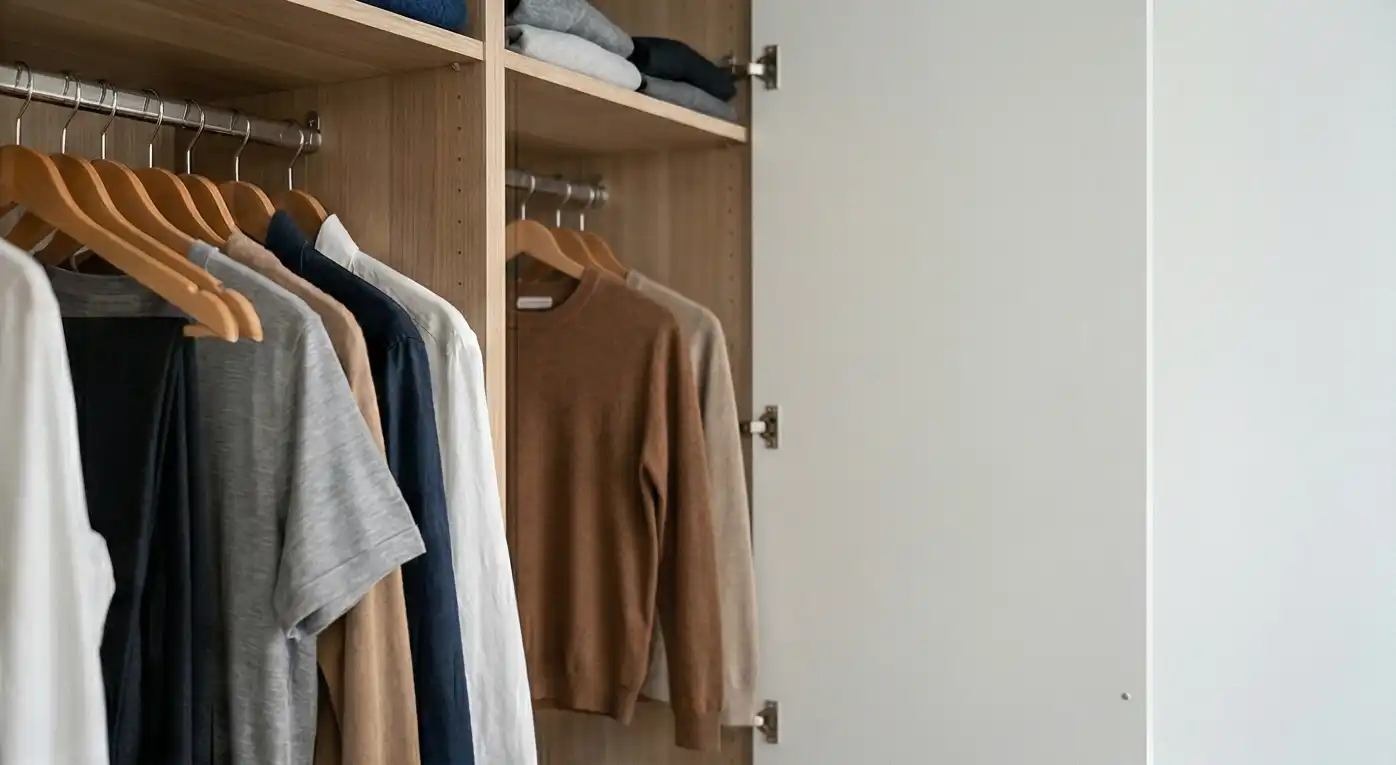
The template that works for most men: 3-4 basics (t-shirt/polo in merino), 2 shirts, 3 pants, 1 unstructured blazer, 2 outerwear pieces (lightweight + heavy), 2-3 weekend/casual pieces. Total: 14-16 pieces. Everything else is surplus.
Phase 3: Strategic Replacement (Weeks 2-4)
This isn’t about throwing everything away and buying new. The method that works is gradual substitution: every time a piece from Category C or B rotates out (through wear, season, or simply because you never choose it), you replace it with a higher-quality piece for your core.
The math is striking. If you spend €30 on a t-shirt that lasts 6 months (20 wears = €1.50 per wear) and replace it with a €125 merino t-shirt that lasts 3+ years (200+ wears = €0.62 per wear), you’re cutting your real cost in half. And meanwhile you’ve eliminated 5 mediocre t-shirts from the cycle, freeing physical and mental space.
The key is not to rush. One piece per month is the right pace. In 6-8 months you’ll have transformed your wardrobe without economic shock and with time to verify that each new piece truly integrates into the system.
Phase 4: Maintenance (Month 2 Onward)
The minimalist wardrobe only works if it has an exit rule: for every piece that comes in, one goes out. No exceptions. This simple discipline prevents the gradual slide back into accumulation — the natural tendency that sabotages 70% of decluttering attempts.
Caring for your pieces becomes equally important. When you have 15 pieces instead of 50, every wash counts. Natural fibers like merino require fewer washes (the keratin structure resists odors) and lower temperatures — extending garment life and reducing energy consumption. A double benefit that makes a real difference at scale.

The Result You Won’t Expect
Everyone who completes this journey reports the same unexpected side effect: it’s not the wardrobe simplification that’s the main benefit, but the mental clarity that comes with it. Knowing exactly what you have, why you have it, and how long it will last frees up cognitive resources you were wasting on daily micro-decisions.
For a detailed guide with seasonal combinations, download free The Invisible Wardrobe: 12 Pieces, 30 Days — the plan we’ve tested and documented. And if you want to start with the most versatile piece in the system, the 17 micron merino t-shirt is the starting point that’s worked for us.
Related Reading
Want to understand the science behind the materials?
Explore Merino University →