
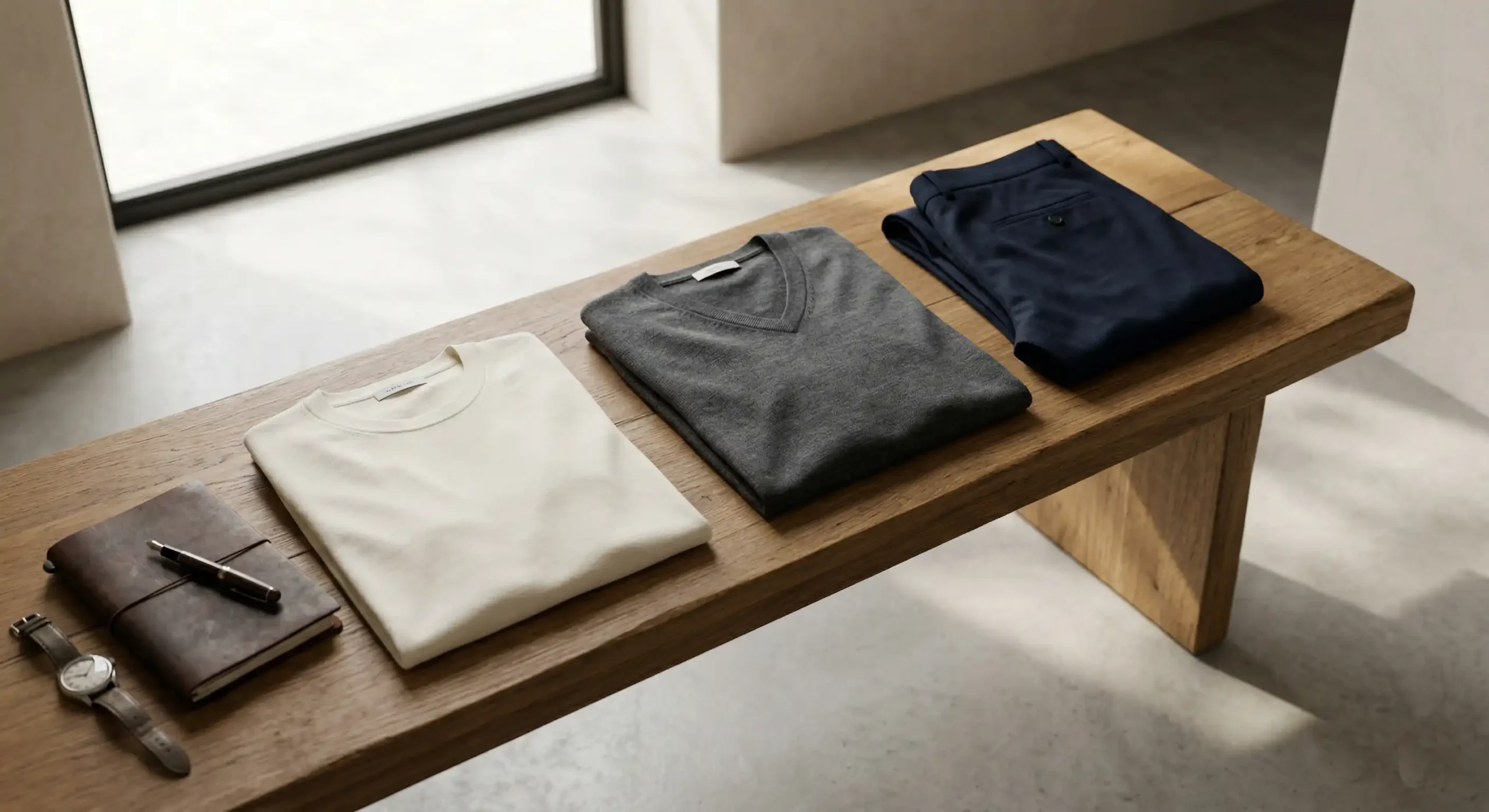
The capsule wardrobe is everywhere: articles, reels, lists of essential purchases. But between the theory of “15 pieces is enough” and the reality of someone who needs to dress every day for the office, weekends, and everything in between, there’s a gap that no one talks about. This article fills it — with data, direct experience, and a perspective that starts with material, not fashion.
The Promise and the Problem
The basic idea is solid: owning fewer pieces, chosen well, reduces decision fatigue and consumption. Cognitive psychology confirms it — Roy Baumeister’s concept of “decision fatigue” shows that every morning choice drains mental resources needed elsewhere.
The problem emerges in execution. Most capsule wardrobe guides suggest generic pieces — “a white shirt, a blue blazer, khaki chinos” — without ever asking: what material? What weight? For which climate?
It’s like designing a house by talking only about rooms, never mentioning construction materials. The result: pieces that lose shape, color, and dignity after three washes. And the “capsule” wardrobe becomes a wardrobe you need to replace every six months.
Why Material Is the First Filter
A minimalist wardrobe that actually works starts with one principle: every piece must withstand intensive use. If you have 15 items instead of 50, each one gets worn three times more often. You need fibers that manage temperature, moisture, and odor without degrading.
Merino wool at 17 micron meets these requirements in measurable ways. The fiber absorbs up to 35% of its own weight in moisture without feeling wet — meaning active thermal comfort, not passive comfort like cotton or synthetics. Practical result: the same piece works from an air-conditioned office to an evening walk without changes.
Odor resistance is the least discussed and most relevant advantage: the keratin structure in merino fiber inhibits bacterial growth, allowing more wears between washes. In a 15-piece wardrobe, this isn’t a detail — it’s what makes the system sustainable.

The Real Test: 30 Days With 12 Merino Pieces
We documented a concrete experiment: one full month dressed in only 12 merino wool pieces, covering professional, casual, and athletic contexts. The results were instructive.
Washing frequency dropped by 60% compared to an equivalent cotton/synthetic wardrobe. Thermal versatility eliminated the need for “transition layers” — those pieces you wear only for the commute then leave on a chair. Morning decision time fell below 3 minutes.
But the most significant finding was economic: the cost per wear (price / number of times worn) for merino pieces was 40% lower than fast-fashion items bought at one-third the price. The quality of the material transforms a higher initial investment into real savings over time.
Where to Start: Three Principles, Not a List
Instead of prescribing the usual “10 essential pieces,” we propose three principles that work regardless of your lifestyle.
First: the 72-hour test. Every piece in your capsule wardrobe must be wearable for three consecutive days without washing and without embarrassment. If the material doesn’t allow this, it’s not a capsule piece — it’s just taking up space.
Second: the dual-context rule. Every piece must work in at least two different situations (office + weekend, travel + dinner). Single-context pieces are the enemy of functional minimalism.
Third: prioritize weight, not aesthetics. A 150 g/m² fabric is perfect for warm months, 190 g/m² covers shoulder seasons. With two weights in merino, you’ve got eight months of the year covered by just two base pieces.
The Next Step
The capsule wardrobe works — when you stop thinking of it as a list of pieces and start designing it as a system of materials. The difference between a failed experiment and lasting change lies in the fiber, not the fashion.
If you want to assess where you stand today, the daily layering checklist on Merino University lets you evaluate your current wardrobe in 5 minutes. And when you’re ready to start with the most versatile piece, discover the 17-micron merino t-shirt that became the foundation of our experiment.
Related Reading
Want to understand the science behind the materials?
Explore Merino University →